
ANCIENT to MODERN
Blue Mehndi is a bridge between ancient wisdom and the modern world, translating timeless truths into a visual language that speaks to today’s soul. Through intricate symbolism, layered storytelling, and a fusion of cultural themes, it preserves the sacred knowledge of the past while making it relevant to now. The style itself—rich, detailed, and deeply immersive—reflects spiritual iconography, and contemporary artistic expression.
BlueMehndi art is a living archive of wisdom, designed to awaken, inspire, and remind us of the deeper connections that shape our existence.
WISDOM
Art is Wisdom
I believe it’s essential to capture culture, our time, and this moment as a reference, so future generations can see, feel, and understand the world as we experience it now.

Ancient wisdom has always been a part of my journey, whether I realized it or not. It was woven into the fabric of my upbringing, appearing in the Vedic scriptures I heard, the Christian teachings my family followed, and the Buddhist principles I encountered.
At times, it felt overwhelming, distant—too vast to grasp. Yet, as I grew, I began to see it everywhere. It wasn’t just in books or rituals; it was in the way people spoke, the way nature moved, the way art carried something beyond words.


WISDOM NEEDS TO BE SHARED
For me, ancient wisdom is not just about knowledge—it is about presence. It is something felt, something remembered, something that exists beyond time. It has shaped the way I think, the way I see the world, and the way I create. I have come to understand that this wisdom is not locked in the past; it is alive, speaking through symbols, through patterns, through the very fabric of existence.
A REFLECTION OF KNOWING
In my own experience, I have seen how easily this wisdom can be lost in the noise of modern life. We are constantly bombarded with information, but rarely do we encounter true depth. Ancient teachings, once revered, are now hidden beneath layers of translation and adaptation, often diluted or dismissed. Yet, every time I return to them, I feel a deep sense of clarity—as if something within me already knew, already understood.
I believe that art is one of the most powerful ways to access this wisdom. Unlike words, which can be misunderstood or debated, art communicates directly.
A single image can hold the essence of an entire philosophy. A single form can unlock something buried deep within a person’s subconscious. My own art has always been a way for me to explore these ideas, to translate the intangible into something that can be seen, felt, and experienced.
This is why I see the presence of ancient wisdom in art as essential. In a world that often feels disconnected, fragmented, and shallow, it offers a bridge back to something real, something enduring. It reminds us that before technology, before industry, before everything we consider "modern," humans were already contemplating the same questions—who we are, why we are here, what it all means. Art becomes a way to carry those questions forward, to keep the dialogue alive, to offer people a moment of connection to something greater than themselves.


ACCESSING STREAMS OF ART
When I create, I feel as if I am tapping into this stream of knowledge, this lineage of thought that has existed for thousands of years. I see it in the shapes I use, the symbols that emerge, the way the pieces seem to speak on their own. I know that not everyone will recognize these elements consciously, but that doesn’t matter—wisdom has a way of finding those who are ready for it.
A VESSEL HOLDING TRUTHS
For me, this is what makes art truly powerful. It is not just decoration, not just expression—it is a vessel. It holds history, meaning, truth. It reminds people that they are part of something much older, much greater, something infinitely connected. And in that realization, something shifts. A door opens. A journey begins
''True sovereignty lies in understanding fantasy, seeing it not as a destination but as a creation. ''

Art is Mastery
When I began developing Blumendi, I was deeply aware of how art has always evolved in response to culture, technology, and human perception. The way people interact with visuals today is vastly different from past centuries, yet at its core, the emotional and psychological connection to art remains the same.
I wanted to create something that spoke to the modern viewer while carrying the essence of classical, spiritual, and historical art. That’s why Bluemendi’s aesthetic is not bound to a single style—it is an amalgamation of history, technique, and innovation, designed to resonate with a contemporary audience.
THE MEDIUMS & STYLES
The evolution of Blumendi’s style is a reflection of both a personal artistic journey and a conscious response to the changing visual landscape of the world. My approach has never been confined to one aesthetic because art, like culture, is fluid. In Blumendi, I’ve explored:
-
Illustration-based art that carries an immediate, graphic appeal.
-
Dramatic paint styles that embrace texture, depth, and emotion.
-
Simplistic abstraction that conveys meaning through minimal forms.
-
Modern contemporary design that aligns with the visual language of today’s branding, fashion, and interiors.
-
Renaissance-inspired religious art, infused with elements from Hindu, Vedic, and Asian traditions, reimagined through Cubism, abstraction, and digital techniques.
Each of these approaches serves a purpose. Art, in its essence, is about connection, and different styles resonate with different audiences. Some individuals are drawn to the familiarity of traditional oil paintings, while others connect with bold, graphic compositions reminiscent of contemporary design. By working across multiple styles, I create art that speaks to diverse tastes, perspectives, and cultural experiences.
STUDY OF ART DISCLIPLINES
I have spent years working across multiple disciplines—illustration, painting, abstract, graphic design, and classical fine art—all to develop an artistic language that is both diverse and immersive. From the dramatic realism of Renaissance and religious paintings from Hindu, Vedic, and Asian cultures to the sharp, clean aesthetics of modern graphic design, I have intentionally integrated multiple styles into Blumendi’s visual identity.
I’ve also drawn from surrealism, cubism, stained glass artistry, textiles, and 3D design, ensuring that my work doesn’t just fit into a singular category but exists as a fusion of techniques, ideas, and eras. The result is a body of work that not only appeals to those with an appreciation for classic art but also to those whose aesthetics are shaped by contemporary culture—by fashion, branding, interior design, and the visual language of modern trends.


PAINT TO PIXELS TO ART
When I was first exploring digital tools, I already sensed that the world was shifting towards a more screen-driven experience. I knew that digital visuals would eventually become a dominant part of human interaction, from branding to entertainment to personal expression. This was in the early 2000s, long before today’s digital landscape had fully formed, but I could already see the potential for a deeper integration between technology and art. Even before that, in the mid-90s, I was immersed in digital experimentation. My mentor in college recognized my drive and gave me full access to his computer lab, where I spent countless hours working with early versions of software like Paint and CorelDRAW. I used an RGB camera—long before modern scanners—to capture images, manipulating them pixel by pixel, exploring how digital colors could be layered and transformed.


MASTERING THE DIGITAL CANVAS
This foundational period was critical. I spent over 12 years replicating historical artworks digitally, creating at least seven renditions a day, every day. It was an intense process—reverse-engineering the way pigments worked in traditional media and finding ways to translate that depth, texture, and emotion into a digital format. Unlike physical paintings, digital art lacks inherent texture, so I developed my own unique methods of layering thousands of textures to make my work feel tangible—like a Renaissance painting, an aged mural, or even an ancient cave painting. Through experimentation, I discovered techniques that aren’t documented in any Photoshop manual or digital art guide. These were my own inventions, born from relentless practice and deep study.
BRIDGING TRADITIONAL & DIGITAL ARTISTRY
Once I mastered pixel manipulation, my approach expanded. I started painting digitally using a stylus, allowing me to bridge the gap between traditional and digital artistry. With this, I could create not only photorealistic works but also highly expressive and textured pieces that felt handcrafted despite being digitally composed. By layering light, color, and form with precision, I could engineer compositions that guided the viewer’s eye exactly where I wanted, telling stories through visual language.
SYMBOLISM, MYTHOLOGY & STORYTELLING
Much of my artistic vision is influenced by storytelling, mythology, and philosophy. I have studied religious and esoteric art extensively—not just for its symbolism but for its ability to create drama, mystery, and deep emotional resonance. Religious art, especially from Hindu and Renaissance traditions, taught me how to evoke awe, how to construct compositions that feel both sacred and dynamic. Every piece of Blumendi artwork is embedded with symbolic depth, but the symbolism is often hidden, abstracted, or stylized so that it connects with people on a subconscious level.
THE CULTURAL AESTHETICS
I’ve also spent years analyzing popular culture, understanding how trends are curated, how they emerge, and how they are shaped by social and economic forces. Style itself is not random—it is engineered. It is introduced, cultivated, marketed, and then absorbed into collective consciousness. Because I understood this process, I was able to develop 50 distinct styles within Blumendi, each designed to either align with or subtly challenge the aesthetic preferences of different audiences. Some pieces feel nostalgic, others futuristic. Some mimic the organic imperfection of handmade art, while others embrace the sharp precision of digital design. My approach was always to think ahead—how would these works resonate not just now but in 20 years? I projected forward to 2026 and designed my work to align with what I believed would be the aesthetic and spiritual sensibilities of that future generation.


THE FUTURE OF BLUEMEHNDI
Ultimately, style is one of the most crucial aspects of Blumendi. It’s what allows the artwork to speak across different audiences and bridge the gap between tradition and modernity. Every color choice, every composition, every layer of texture is intentional. Whether someone is drawn to Blumendi because of its connection to spiritual art, because it complements their personal aesthetic, or simply because it feels fresh and intriguing, the underlying purpose remains the same—to create art that resonates deeply, that tells a story, and that exists as both an artifact of history and a vision of the future.
I’m truly excited to share these works and to see how people connect with them.
I guide the viewer to see reality differently—to step beyond the habitual ways of thinking and feeling and into a space where we can truly observe, reflect, and redefine the world we believe to be real.

Art is
MODERN
Blumendi is not just an artistic exploration—it is a bridge between the ancient and the modern, a transformation of deep philosophical and spiritual concepts into visuals that resonate with a contemporary audience. The challenge I encountered was that many of these narratives—rooted in ancient wisdom, mythology, and esoteric philosophy—are often difficult to access, decode, or even appreciate for those unfamiliar with them. The traditional way these stories have been depicted, using historical artistic conventions, often limits their reach to specific cultures or communities.
But I am not from ancient times—I am here, now, living in a digital era, expressing these ideas through a contemporary lens. My goal is not to recreate history but to reinterpret it, breathing new life into these profound narratives and making them visually engaging for people who may have never been exposed to them before.
BREAKING FREE FROM TRADITIONAL ARTISTIC CONSTRAINTS
In traditional depictions of ancient figures, mythology, and sacred symbols, there are often fixed expectations—certain colors, compositions, and styles that define how these subjects should be represented. But I do not adhere to these conventions. Instead, I create adaptations based on intuition, emotion, and my personal interpretation of how they should be portrayed.
Rather than being confined to a single artistic style—whether classical, figurative, abstract, or profile-based—I allow each artwork to evolve freely. I incorporate modern influences, drawing inspiration from contemporary art, design, and visuals that people around the world already connect with. By completely reimagining the traditional aesthetics of these narratives, I offer something new—something that does not require historical knowledge to be appreciated but instead invites curiosity and engagement on a more personal level.
TRANSMUTATION INSTEAD OF DILUTION
It was never my intention to dilute these powerful stories; instead, I sought to transmute them into something that transcends cultural and historical barriers. The core essence remains intact, but the way it is presented shifts—like a frequency adjusting to different wavelengths, making it accessible to a broader audience.
By changing the traditional version into something entirely new, I remove the need for explanation. The visual itself becomes the entry point, sparking intrigue and inviting people to engage with these ideas without feeling alienated by unfamiliar symbols or styles. This way, someone who may have never encountered Hindu mythology, Buddhist philosophy, or esoteric wisdom before can experience it in a way that speaks to their existing sensibilities.

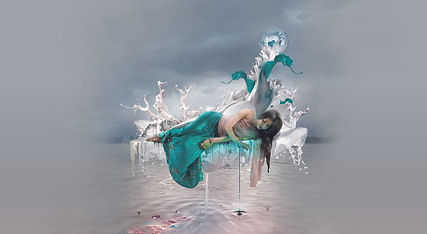
A NEW WAY TO EXPERIENCE PHILOSOPHY AND SPIRITUALITY
Blumendi is not just about visual art—it is a concept that extends beyond the canvas. My vision is to develop it into an entire brand that integrates ancient wisdom and philosophy into modern lifestyle aesthetics. This includes not only artworks but also fashion, furniture, and immersive design experiences that allow people to engage with these ideas in ways that feel natural and inspiring.
By embedding these narratives into everyday objects, interiors, and wearable art, I make them a seamless part of modern life rather than something distant or purely intellectual. It is about creating new ways for people to experience philosophy—not as something abstract or academic, but as something they can see, feel, and live with.
BLURRING THE LINES BETWEEN THE FAMILIAR AND THE UNFAMILIAR
At the heart of Blumendi is a question: How do we bridge the gap between the known and the unknown? How do we take something deeply rooted in one culture, one era, one tradition, and make it feel universal?
The answer lies in transformation. By altering the aesthetic while preserving the essence, I create visuals that feel both familiar and unfamiliar at the same time—pulling people in with a sense of recognition while offering them something entirely new. This is where the magic happens.
The more we see beyond cultural boundaries, the more we realize that these stories—of gods and demons, heroes and journeys, creation and destruction—are, at their core, deeply human. And when presented in a way that resonates with modern sensibilities, they can find a place in the lives of people from all walks of life.
Blumendi is my way of making that connection possible.
Fantasy is also deeply connected to our conditioning. We are taught what to fantasize about—whether through culture, media, or societal structures. Some fantasies serve to inspire, while others are designed to keep people chasing something they may never truly reach. This is where the line blurs between fantasy as a tool for expansion and fantasy as a means of control.
TO LEARN MORE ABOUT THIS UNIQUE ARTISTIC JOURNEY, CONTACT JAI SOL'S AGENT VIA EMAIL, OR ALTERNATIVELY, VISIT THE 101 CURATION WEBSITE TO BE PART OF HIS EXCLUSIVE CURATION EXPERIENCES.